
Legal disclaimer: all ongoing investigations that have not resulted in an indictment are allegations
Trigger warning: this article discusses sensitive topics related to sexual violence; please take breaks and read at your discretion
On September 21, out to celebrate turning 17, a girl was gang-raped by three men posing as police officers in Southeast Delhi. She was a resident of Faridabad, where she went to school, and she had gone to a temple to offer prayers with a friend.
They were walking in the evening through the park, but were approached by three men who asked to see their identification. They were threatened with guns, and her friend was separated and held while the three men sexually assaulted the girl one after another.
A week earlier, another 17-year-old was gang raped and then stabbed to death. Her body was discovered in a field days later, half eaten by dogs. In September alone, the rape of an 11-year-old and a six-year-old were also reported.
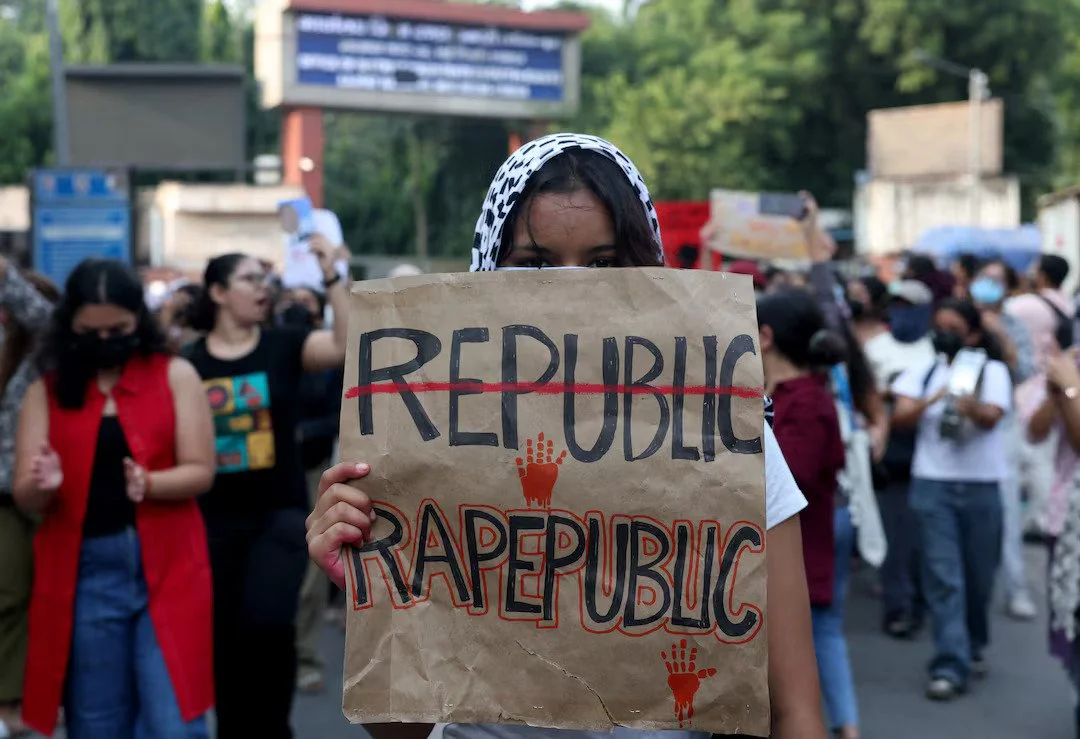
In the following weeks, thousands of protestors have taken to the streets, protesting their government’s response to a rise in sexual violence across the country. Every 20 minutes a woman is raped in India, with the true scale estimated to be higher due to chronic under-reporting.
Rather than holding the perpetrators accountable, women in India are told by their government to fend for themselves and “be safe.”
“Again and again, women are told to stay indoors, to not go out at night, to cover ourselves, to protect ourselves,” Vaishnavi Dhruw, a 21-year-old history student at Delhi University, said. “When will society tell men in our country not to rape?”

India’s response to sexual assault and rapes is telling, but consistent with how authorities across the world approach sexual violence. Society expects women to prevent being assaulted by taking calculated caution, but if their clothing is deemed “too revealing,” or they get “too drunk,” suddenly it's their fault.
In our world, there exist people who have committed no sin, but are labeled criminals, terrorists and threats to society.
On the other hand, there exist individuals who have committed sins so heinous, so evil, that words cannot begin to describe their disgusting nature. Yet instead of punishment, they’ll be asked to write essays, pay a fine, or in a lot of cases, do absolutely nothing.
The justice system fails thousands, if not hundreds of thousands, of survivors every year across the world; women who are victims of the most evil acts a man can commit but far too often don’t receive the justice they deserve.
This is because the justice system was never designed to protect the survivors or to actually uphold justice. It is in place to protect those in power, reinforce patriarchal oppression and silence dissent.
Here are the stories of women across the world who are not only victims of sexual violence at the hands of men, but also a justice system that was designed to ensure these very sinners will never be called criminals.
Jane Doe and Cornell University
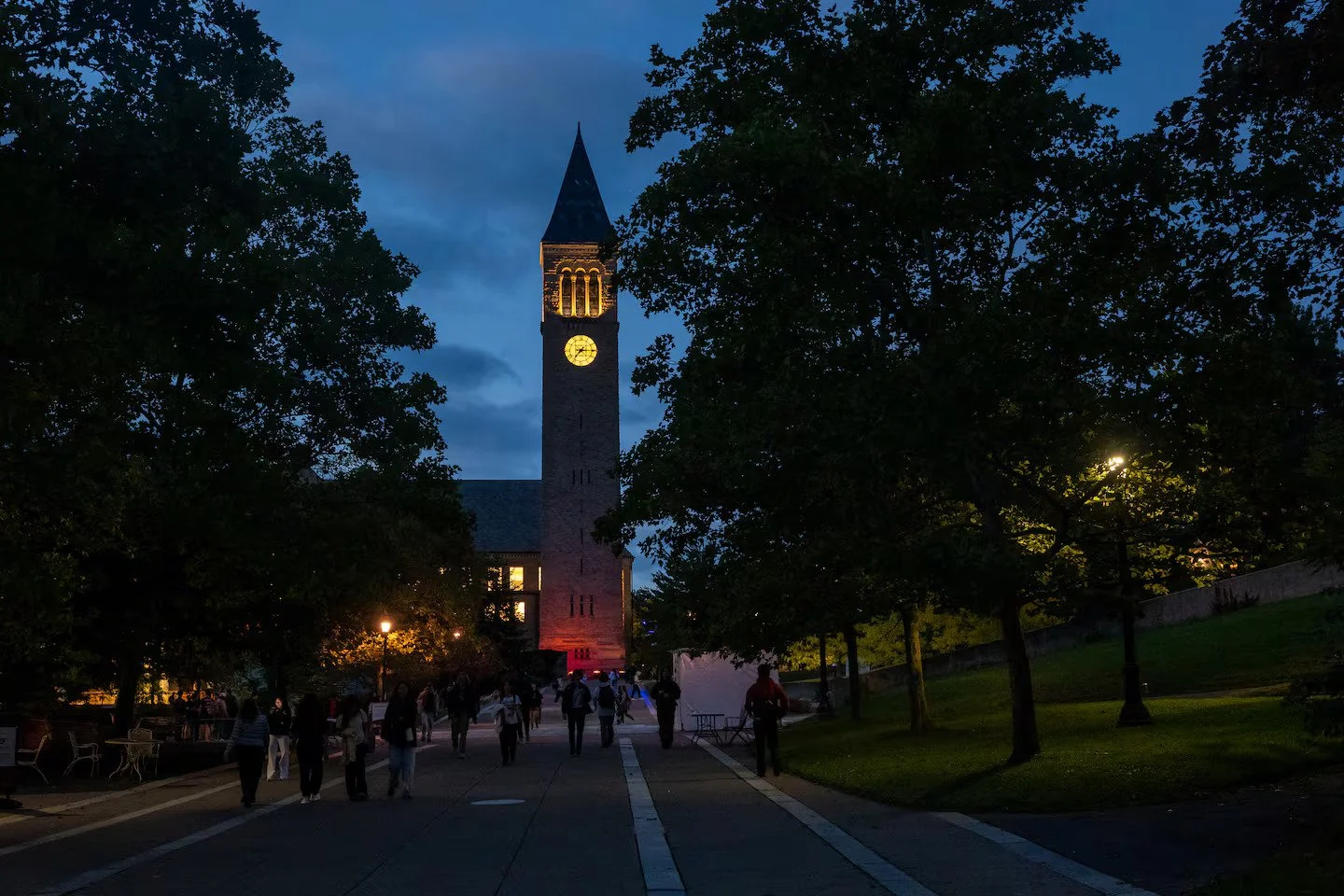
A recent lawsuit filed in the New York County Supreme Court Docket has caught the nation’s attention because the perpetrators and their wrongdoings are so clear and obvious. And yet, it has been two years without Jane Doe, the anonymous victim, receiving any form of reparations for the trauma she endured.
On the night of Oct. 19, 2024, Jane Doe was intoxicated after a night out with her sorority sisters. She and her friends were at a Tri-Delta National’s Alpha Beta Chapter event hosted at Moonies Bar & Nightclub. She was clearly marked underage and intoxicated, but was still served more alcohol by employees.
At 11 p.m., she left the bar by herself and stumbled alone to the Chi Phi fraternity house in Ithaca to see a man she thought was her friend. She was then given ketamine and more alcohol, despite being clearly intoxicated. Ketamine is a dissociative anesthetic, and before long she was incapacitated.
The man proposed having a threesome with him and another fraternity brother, but she was incapable of consenting.
The lawsuit alleges she was gang raped by multiple fraternity members and was coerced to do lines of ketamine until 5:45 the next morning. For seven hours, she was groped, assaulted, and raped by fraternity members at Chi Phi.
During the alleged incident, a group chat with 57 fraternity members on Snapchat called “Chi Phi Activities” was blowing up, with members saying “free pussy upstairs,” and another later asking at 1:42 a.m., “shop still open?”
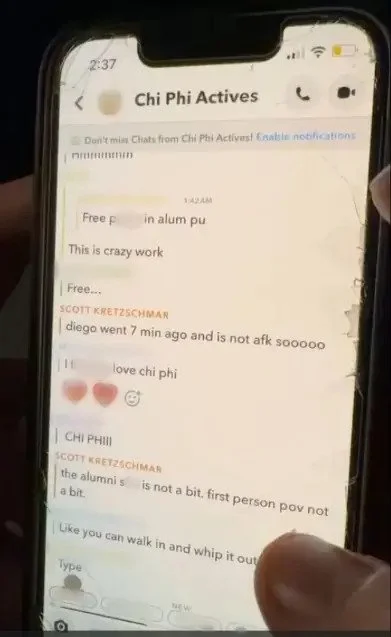
Not one of the men in that group chat reported the incident to authorities. Not a single one spoke up.
Many members of the fraternity entered the room throughout the night, while Jane Doe tried to hide under the covers of the bed. She tried pushing the assailants away, but her phone was on the other side of the room.
According to court documents, she “felt as if there was no way for her to escape this room full of predatory fraternity men.”
Days after the alleged incident, Doe went to Cornell Health to get treated for a urinary tract infection she contracted from the incident, and got tested for sexually transmitted diseases.
“Ms. Doe disclosed to the treating health care professional that she contracted the UTI in a ‘traumatic way,” her attorney Thomas P. Giuffra said. “Ms. Doe’s disclosure warranted further inquiry, including a rape kit, consultation of medical professionals trained to deal with rape cases and a physical exam to document her injuries. Inexplicably, all the medical professional did was advise Ms. Doe to ‘speak with somebody.’”
Timing is crucial for rape kits because DNA evidence is lost over time, DNA that could have served as vital information in a criminal investigation.
She filed a report with the university’s police department three weeks later, after dealing with intense pain and grief as a result of her trauma. Cornell conducted its own Title IX investigation, which differs from a criminal investigation.
After 12 hearings, only two of the seven believed perpetrators were expelled, while others received lesser punishments in exchange for writing essays and attending workshops.
“Not one of these guys was arrested,” Guiffra said. “Not one.”
The Tompkins County District Attorney Matthew Van Houten claimed to have “conducted a thorough review of the police investigation,” but said there was “insufficient evidence” to support criminal charges.
However, the reason further charges weren’t pressed is believed to be in large part due to New York’s penal code that contains a loophole making it possible for an assaulter to rape an individual and get away with it so long as the victim was voluntarily intoxicated.
Under New York law, a person is guilty of rape if they engage in sexual conduct with an individual who is “incapable of consent by reason of being mentally disabled or mentally incapacitated.” However, a person is only considered “mentally incapacitated” under law if they were intoxicated without their consent.
To be clear, under this law, victims are denied justice simply because they willingly became intoxicated.
Consent for drinking is not consent for sex, despite what this law might imply. District Attorney Van Houten said he was constrained by this law when investigating Jane Doe’s case, which is why he said he didn't initially pursue criminal charges.
Now, two years later, Jane Doe filed a lawsuit against her university and the seven perpetrators: Matthew Ingalls, Jonathan Newell, Winston Lee, Gillio Lopes, Diego Sarabia, Scott Norris and Scott Kretzschmar.
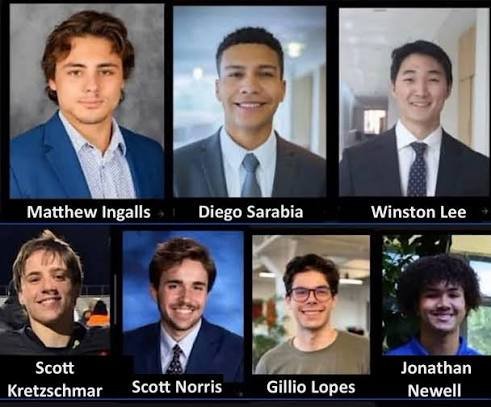
This lawsuit is also filed against Cornell University for violations against the New York State Human Rights Law, the New York Education Law and more.
On Sept. 28, authorities announced that the investigation will be reopened, after Jane Doe filed her lawsuit earlier that month.
“I have been asked by the community to revisit the decision whether to pursue criminal charges against the seven fraternity members,” Van Houten said in a written statement.
According to a cache of documents obtained by the New York Times, Cornell’s investigation contained hundreds of pages of emails, text messages, photos and interviews with Doe and her friends, and the perpetrators. Most importantly, this newly surfaced collection of information contains a transcript of her report with Cornell Police.
In November 2024, Doe explicitly told campus police, “I can say with 100% confidence I was raped.” She went on to recount her experience, asserting that she was raped by these men several times throughout the transcript.
Cornell claimed to have provided all information and testimony to prosecutors, while Tompkins County District Attorney Mathew Van Houten said his office never received this transcript.
Furthermore, according to a statement from Ithaca’s Mayor Robert Cantelmo, Cornell University administrators and police failed to contact or coordinate with the Ithaca Police Department.
“The University failed to hold the perpetrators to account,” Cantelmo said in a written statement. “This is a miscarriage of justice and continues to pose a significant threat to students and residents who may be victimized at unsafe and under-monitored on-or-off campus student events.”
Shortly after the lawsuit was filed, the City of Ithaca moved to suspend all student event and special event permits, including Greek life at Cornell University. This suspension was approved and put into effect, with the state police given a role in this ongoing investigation.
Kate Manne, a professor at Cornell, writes about what life has been like on campus since this news broke.
“As a professor at Cornell, I have had many, many victims in my office, confiding in me their experiences of sexual assault and harrassment,” Manne wrote in a piece for The Cut, a New York magazine.
“Many didn’t even try to report them to the police or the university, and for those who did, the experiences and the outcomes have rarely been positive.”
Often, victims of assault have to publicly come forward with their stories and garner public favor to receive justice, simultaneously exposing them to more risks and threats. It’s a catch-22: to put pressure on law enforcement agencies to take their case seriously, they must publicize it, but by publicizing it, people online shame them, explicitly threaten them and even dox victims by posting personal and sensitive information.
An article posted in the American Journal of Community Psychology looks into what happens to victims who do come forward to trusted loved ones. “Being Silenced: The Impact of Negative Social Reactions on the Disclosure of Rape,” by Courtney E. Ahrens, finds that rape survivors who initially disclosed their assault experienced negative reactions, leading them to stop talking about their experiences entirely.
These victims are doubted or blamed, and a majority of victims experience negative social reactions from the people they confide in.
“When rape survivors are exposed to victim-blaming behaviors or attitudes, the experience may feel like a second assault, a phenomenon known as secondary victimization,” the article writes. “Speaking out about the assault may therefore have detrimental consequences for rape survivors as they are subjected to further trauma.”
In the case of Jane Doe, District Attorney Van Houten only reopened the case after the public outrage, which we know by his own admission. But as a result of this publicity, Doe has been exposed to victim-blaming, harassment and attempts to expose her identity.
This negative reaction sits on a scale that reaches beyond the scope of Ahrens’ study, with mental health impacts that have yet to be properly researched in the field of psychology.
In the separate case of another Jane Doe, a rape survivor of former Idaho lawmaker Aaron von Ehlinger, her identity was exposed by another former legislator, Priscilla Giddings. Von Ehlinger was sentenced to 20 years in prison a year after he assaulted and raped Doe in his apartment, who was a 19-year-old intern at the time.
Before the sentence was levied on von Ehlinger, Giddings reposted an article from a right-wing publication on her official social media page containing personal information about Doe, such as her name and photos.
In 2023, Doe filed a federal lawsuit against von Ehlinger and Giddings for violating her First Amendment rights.
“Representative Giddings doxxed 19-year-old intern Jane Doe, publicly sharing the survivor’s name and photo with constituents using her state email address and server,” the ACLU of Idaho wrote in a formal statement. “This is unacceptable and she must be held accountable.”
Today, countless people have taken to social media with their own “I am Jane Doe” posts. As many try and expose the survivor of the Cornell rape after the lawsuit was filed, these posts are intended to stand in solidarity with the survivor. The logic is that with numerous similar posts, the many Jane Does across the world would have some level of comfort online when they share their stories.
“It was to confuse the AI models and stand in solidarity with her,” said Kelsey Combe, who made one of these social media posts.
Combe’s plan worked, and artificial intelligence linked her as the actual Jane Doe who sued Cornell, according to reporting by the Associated Press.
“It’s also acknowledging that, to an extent, we are Jane Doe,” said Combes, “the majority of us have our own experiences with sexual assault.”
“These moments are encouraging more women to speak up and tell their stories,” Emma Davidson Tribbs, founding director of the National Women’s Defense League, said. “They are giving people a level of bravery and comfort to come forward and speak their truth, and they can be incredibly catalyzing for change.”
Kendall Francis and Louisiana State University
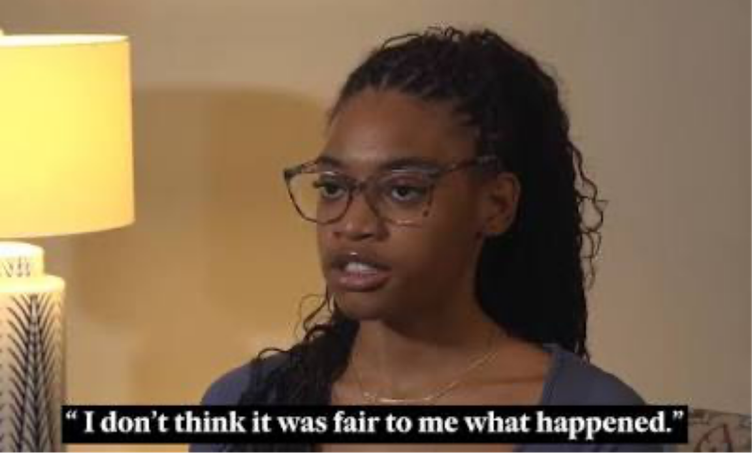
In the case of Louisiana State University student Kendall Francis,, the man who assaulted her was found guilty of rape, but was still allowed to play for the university’s football team.
In October 2025, Francis was raped by an LSU defensive end Damien Shanklin. After the incident, Francis was taken to the hospital and asked if she wanted to press charges.
Shanklin’s mother reached out to Francis, asking her not to press charges because it would “ruin his career,” and she was offered $1,000 to keep quiet.
She didn’t. She filed a Title IX charge, a process that started in December and lasted until the start of LSU’s 2026 Fall semester. Originally, Shanklin was suspended, but days into this year’s semester Francis was informed via email that his punishment was modified and he was allowed to remain on campus and was allowed to continue playing for the team.
Out of concerns for her safety, she moved her classes online. Meanwhile, Shanklin was allowed to walk around campus and continue with his life as if nothing had happened.
“Now I am just trying to speak on my story, because LSU does really protect their athletes, especially their football players,” Francis said in a social media post in September.
LSU did not communicate or work with law enforcement, and did not inform Francis that the Title IX complaint was separate from filing criminal charges.
However, after seeing Francis’s post, East Baton Rouge Parish District Attorney Hillar Moore announced it was launching a criminal investigation.
“I was under the impression that because LSU found him responsible, that LSU would do their part; that criminal charges, you know, would be pursued,” Francis told WAFB, a local Louisiana news station.
Shanklin was not criminally investigated. He was not suspended. He wasn’t even asked to write an essay. He was simply put on probation, allowed to attend classes and play for the football team, despite being found guilty according to the university’s own investigation.
Emma Sulkowicz and Columbia University

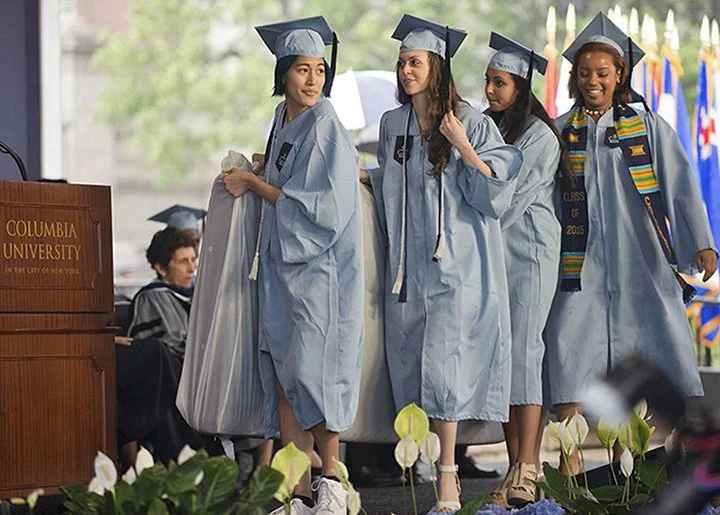
During her sophomore year at Columbia University in 2012, Emma Sulkowicz was allegedly raped by classmate Paul Nungesser on her dorm room mattress. Carrying her mattress everywhere she went as part of her senior thesis years later, she carried the weight of the trauma and pain endured by her and many others.
Initially apprehensive about reporting the incident, as she didn’t want to deal with the emotional trauma, she quickly realized she needed to do something when two other women told her the same person had assaulted them.
All three women came forward with their stories. All three cases were dismissed. It was seven months after Sulkowicz’s incident that she was given a hearing. In a Time Magazine piece written by Sulkowicz, she recounts having to explain to a panelist how anal rape was possible, who for some reason needed this graphic explanation from the survivor.
Ultimately, the assailant was never brought to justice and Sulkowicz had to attend the same university as the man who assaulted her.
“I was raped in my own dorm bed and since then, that space has become fraught for me,” Sulkowicz said. “I feel like I’ve carried the weight of what happened there since then.”
She carried this trauma, in the form of her mattress, everywhere she went her senior year, even across the stage when she graduated. University President Lee Bollinger, who shook everyone else’s hand, turned away when it was time to shake her hand.
Stories like these not isolated incidents, but rather part of a larger trend of sexual violence on campus that continues to deny survivors justice. According to a national hotline for sexual assault RAINN, one reported rape every 20 days occurs for victims between 17-24.
One-third of all rapes reported to law enforcement come from college-age victims. Furthermore, a 2019 Campus Climate Survey found that one in every four undergraduate women experience rape or sexual assault after enrolling.
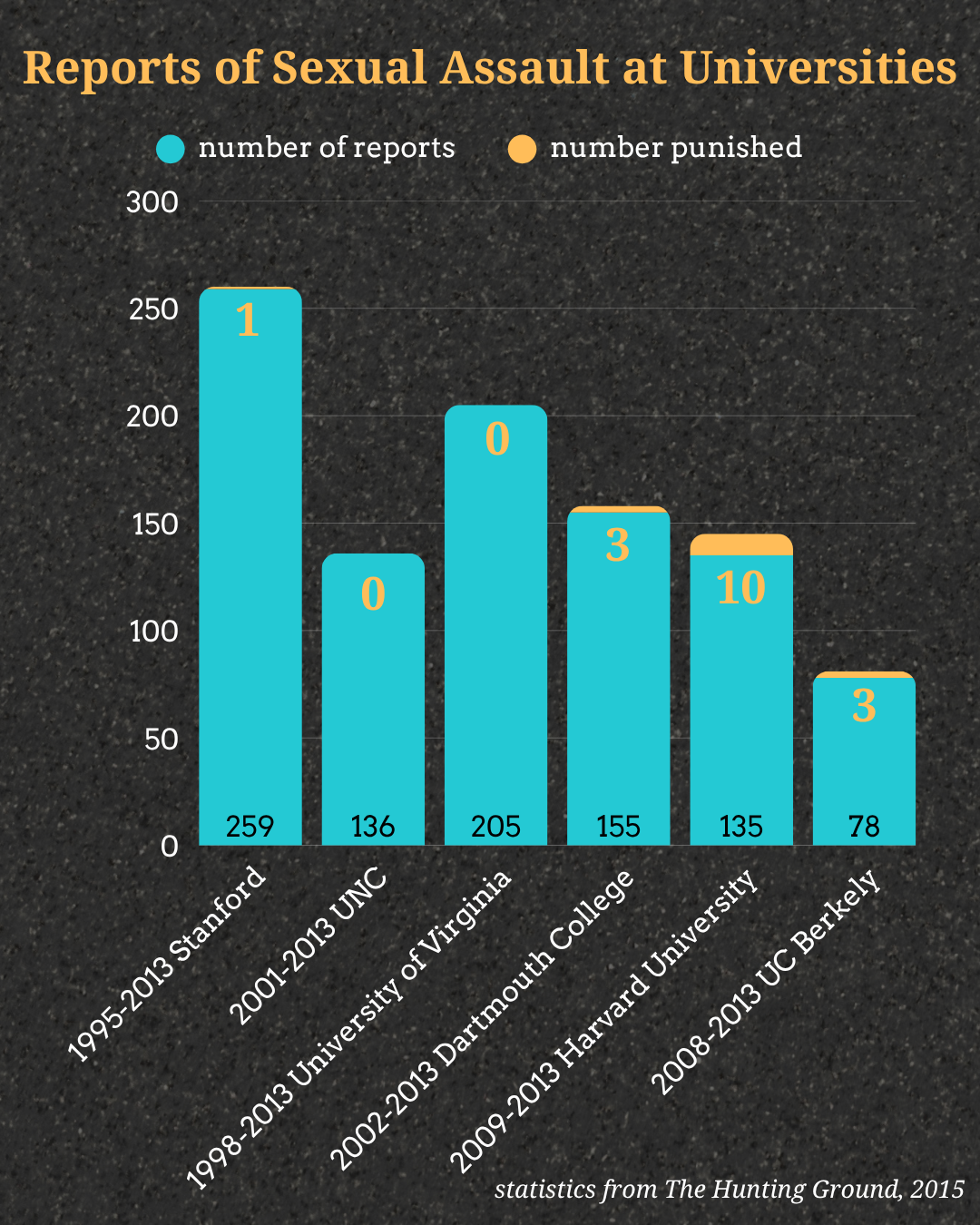
Perpetrators going unpunished is part of a larger trend of universities turning a blind eye to these acts of violence. From 1995-2013, 259 cases of sexual assault were reported at Stanford University, but only one was expelled. In other cases, from 2001-2013, 136 cases of sexual assault were reported at the University of North Carolina, and not a single one was expelled. In a similar fashion, the University of Virginia saw 205 reported cases of sexual assault, with zero expelled. These statistics are from the movie The Hunting Ground, and in 2015, Cornell University even screened this movie and asked how their record compared.
Cornell was so quick to punish pro-Palestine advocates on campus, but it has taken two years and a lawsuit for Jane Doe’s story to come to light.
The US justice system is a testament to a history of standing on the side of the oppressor and persecuting the oppressed; a dynamic still at play today. A justice system where criminals and sinners can be mutually exclusive cannot be trusted, and until this history is reckoned with, oppression will keep its gavel and robe.